
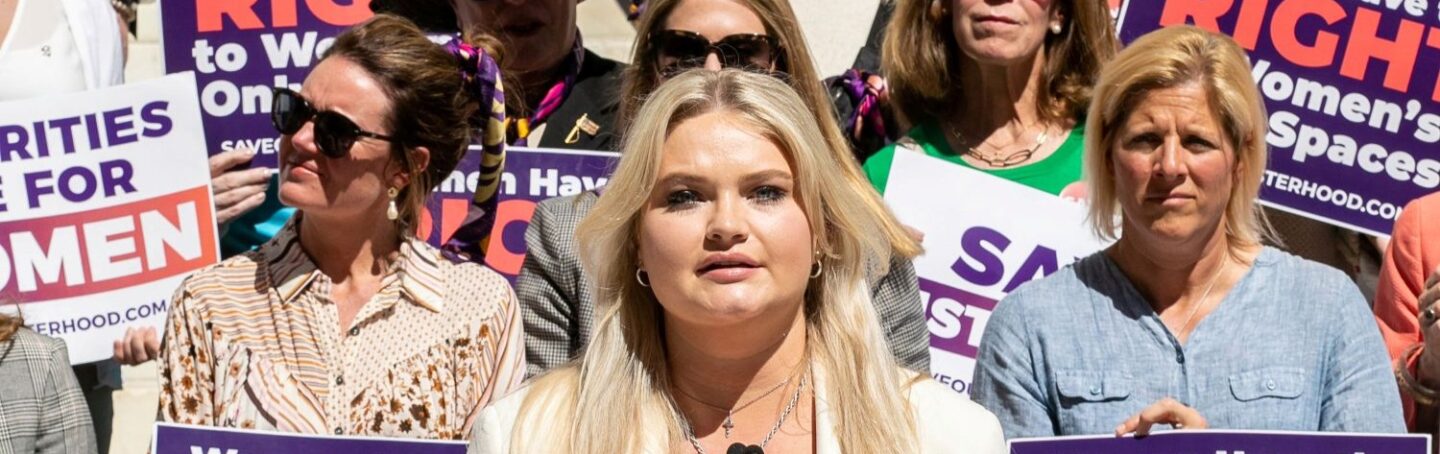


A few short years ago, I would’ve never imagined myself being invited to the White House to participate in a roundtable discussion. Yet thanks to the Trump administration, I had the unique privilege to share my story on how woke extremism has led us to abandon women’s privacy and safety on college campuses.
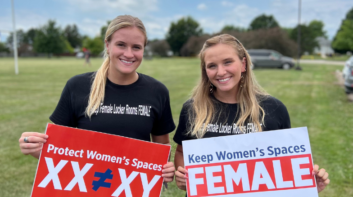
As I walked into the White House earlier this month, I carried something with me that has shaped nearly every day of my life for the past three years: the experience of being forced to share my sorority with a male, despite many girls’ concerns.
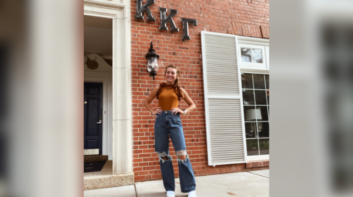
As a student at the University of Wyoming, I dreamed of joining a sorority. I was honored to accept a bid from Kappa Kappa Gamma, an organization whose mission and purpose I deeply believed in and made pledging all the more meaningful.
When I went through sorority recruitment, I assumed Kappa Kappa Gamma upheld the values generations of young women before me had cherished, and that my chapter believed as I did: that a sorority should be a space for sisterhood, privacy, and community.
That foundation was shattered when leadership pressured us to accept a man into our chapter. Our sorority house—once a place where women could relax, confide in one another, and feel safe—suddenly became a battleground for ideological activism.
The whole situation was deeply troubling for me and many of my Kappa Kappa Gamma sorority sisters. Some girls no longer felt safe or comfortable doing basic things like showering or changing within the house, especially those with histories of sexual assault.
When we expressed our discomfort, however, we were dismissed, shamed, or told we were overreacting. And when several of us sought accountability through legal action, the courts brushed us aside, claiming Kappa Kappa Gamma’s bylaws don’t define what a woman is.
That is why sitting in the White House felt so surreal. Elected officials and leaders in charge are at last taking this seriously. After almost three years of being pushed to the side, having our case dismissed, and being called dramatic, women’s rights and safety are finally becoming a priority again.
I feel a profound sense of relief knowing the Trump administration is being proactive. They haven’t simply acknowledged the concerns of students across the country who have been impacted by biased professors, woke administrators, and DEI-driven policies, but they have acted on them. It felt powerful to be in a place where women’s experiences and stories weren’t treated as an inconvenience to their narrative, but as the truth.
One of the most eye-opening parts of the discussion was hearing firsthand the reasoning behind dismantling the Department of Education, a major Trump administration priority. For years, the Department of Education has pushed policies that blurred sex-based boundaries, pressured universities to adopt radical gender ideology, and left students like myself unprotected. Having lived through these policies myself, structural change—not just minor policy adjustments—is much needed.
For me, the most impactful part of the meeting was understanding that what happened to my Kappa Kappa Gamma sorority sisters and me is finally being recognized by the federal government as what it always was: evidence of a system that prioritized ideology over women’s needs.
In just under one year, the Trump administration has re-affirmed support for the original wording and intent of Title IX, issued an executive order to keep men out of women’s sports, reclaimed sex-based definitions, and begun holding universities accountable for encroaching women’s spaces.
In June, the Department of Education’s Office for Civil Rights additionally launched an official investigation into the University of Wyoming, stating that a school receiving federal funding must meet its obligations under Title IX to protect its students from sex-based harassment and sexual assault, as defined by federal law.
All of this shows the federal government now supports single-sex spaces and is working to ensure that the safety, dignity, and fairness women fought for cannot be erased by ideology or intimidation.
I am forever grateful for the opportunity to use my story for the common good, and am especially thankful to the members of the administration who are working hard to get our country’s higher education back on track. My hope is to continue empowering girls and women to speak out against destructive policies, to reclaim spaces that are rightfully theirs, and to ensure no young woman has to sacrifice her safety for ideology. Women’s voices, privacy, and safety are not negotiable.